Pierre Bonnard: The Window (1921)
In this week’s parsha, Parshat Balak, Bilaam says Mah tovu ohalecha Yaakov, “How good are your tents, Yaakov.” Rashi, quoting Chazal, says that Bilaam was praising the Jewish people’s tzniut. Whenever I come back to that Rashi, I think of a Chassidic story my rebbe told us when I was about fifteen years old. The story startled me because it sounded so different from the way tzniut was usually taught.
One Shabbos, the Chozeh of Lublin was staying with R. Barukh of Mezhbizh, the grandson of the Baal Shem Tov. At the Shabbos afternoon meal, as the family sat together, the Chozeh found himself seated next to one of R. Barukh’s daughters. He was uncomfortable. He felt that it was not tzanuah for a woman to sit next to him.
Barukh sensed the Chozeh’s discomfort and did not let it pass. He pointed him to a pasuk in Tehillim, where David HaMelekh pleads with God: Ha’aver einai mei-re’ot shav, “Avert my eyes from seeing falsehood” (Psalms 119:37).
“Listen to the words,” R. Barukh said, rebuking him. “David does not ask God to remove from before him whatever he should not see. He asks God to help him avert his own eyes. Not to make it impossible for him to see, but to help him not look.”
In other words: why should your discomfort become my daughter’s burden? The pasuk makes a demand of the one who looks, not of the one who is seen.
And with that, the matter was settled. The family went on with the Shabbos meal.
I still remember hearing this story for the first time and being startled by it. I was raised in a world where tzniut was spoken about constantly, but the emphasis fell almost entirely on women: how they dress, where they sit, how they appear, and how careful they have to be in public.
The story pushed back against that whole way of thinking. Why should the burden fall so heavily on the person being looked at, rather than on the person who is looking?
That is what made the story so striking to me. R. Barukh was not denying the value of tzniut. He simply refused to let it become one-sided. His daughter was sitting at her father’s Shabbos table. The problem was not her presence, but how the Chozeh should respond to his own discomfort. That discomfort may have been real, but it was not hers to solve.

Yoram Raanan: “Balaam’s Donkey”
Chazal, I think, hear the same demand in Bilaam’s blessing.
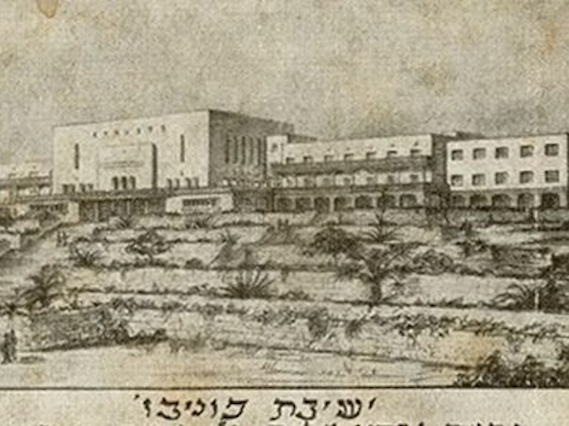
When Bilaam blesses the Jewish people, he says the famous words: Mah tovu ohalecha Yaakov, mishkenotecha Yisrael, “How good are your tents, Yaakov, your dwelling places, Yisrael.” He praises their tents; Rashi, quoting Chazal, understands the compliment to refer to the way those tents were arranged: she’ein pitcheihem mechuvanin zeh mul zeh, their openings were not aligned with one another. When one family looked out from its own entrance, it was not looking straight into another family’s home.
At first glance, this is simply a praise of modesty. And it is. But Chazal frame that modesty in a very specific way: the focus is less on people making themselves invisible, and more on people making sure not to look into someone else’s space.
They do not speak of families closing themselves off from view. Rather, each family arranged its entrance so that one door did not face another, so that looking out from one tent did not mean looking into someone else’s home.
That is the deeper point Chazal hear in Bilaam’s words. The beauty of the camp was that each family took responsibility for the way its own home faced someone else. Kedusha was built not only by guarding one’s own space, but by honoring the space of the next person.
This is not only an ethical intuition; it also carries halakhic weight. In hilkhot nezikin, when my property or behavior may cause damage to someone else, I cannot simply say, “Protect yourself from me.” Often, al ha-mazik leharchik et atzmo: the one creating the risk has to move away from the place where he might cause harm. The camp described by Chazal reflects that same structure. If my doorway opens into your private space, the burden is on me to arrange my doorway differently.
At R. Barukh’s table, the Chozeh is told to take responsibility for his own eyes. In the camp of Israel, each family arranges its own doorway so it does not look into another family’s tent. In both, the demand is simple: do not make your looking someone else’s burden.
This is tzniut in a broader sense. Clothing matters, and so does the way men and women share public space. But tzniut also reaches beyond that. It is about remembering that my ability to look does not mean I have a right to look.
That matters for kedusha. A holy community is not created only by rules about what may be seen. It is also created by people who know how to place limits on themselves. Sometimes that means how I dress or speak or carry myself. And sometimes it means how I look, where I stand, what I allow myself to notice, and what I choose to leave alone.
That does not erase the standards of tzniut. It deepens them. Tzniut cannot rest only on the person being seen. It also has to rest on the person who sees.
Mah tovu ohalecha Yaakov.
How beautiful were those tents.
Because each family understood: my doorway is my responsibility. My gaze is mine to guard.


 Daf of the Day